
Plumbing Permits and Inspections: What Needs One and What It Costs
- 05 Sep, 2026
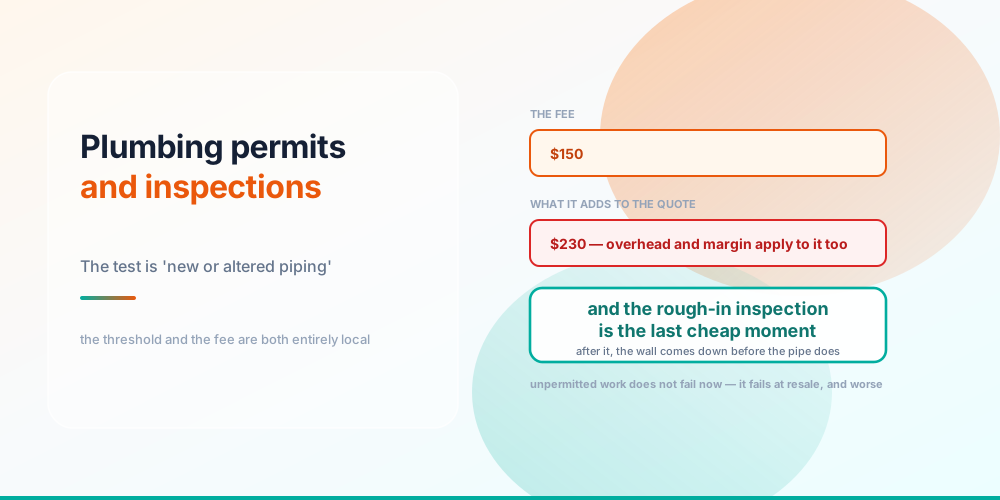
Permits are the part of plumbing everyone wants a straight answer about and nobody can give one, because the threshold, the fee and the number of inspections are all set locally and vary by an order of magnitude.
What is consistent is the shape of it. The test is almost always whether you are creating or altering piping, and the sequence of inspections has one step in it that matters far more than the others.
What needs one
The test is usually 'new or altered piping'
Almost always needs a permit: adding, moving or removing a fixture; any new or altered supply, drain, waste or vent piping; replacing a water heater; repiping; a new building sewer or water service; converting an appliance’s fuel.
Usually does not: clearing a blockage; replacing a faucet, valve or trap in the same place; swapping a fixture for the same fixture on the same connections; replacing a washer, cartridge or flapper.
Genuinely varies — and this is the column worth a phone call: like-for-like water heater replacement (permitted in most places, not all), moving a fixture a short distance within a room, water treatment equipment on the service, and anything that changes a vent.
Note also that the building sewer is frequently permitted separately from the plumbing inside, sometimes by a different department and occasionally requiring a different contractor licence. Where that boundary sits is in building drain vs building sewer.
The sequence, and the step that matters
One step in this sequence is irreversible
Apply. Scope, sometimes drawings, sometimes just a fixture count.
Rough-in. Pipe in, nothing covered, system holding a test pressure.
Rough-in inspection. The point of no return.
Close up. Insulation, drywall, tile, fixtures.
Final inspection. Fixtures set, everything working, air gaps present.
Sign-off. The record that turns up at resale.
Everything before the rough-in inspection is cheap to change; everything after it is behind finishes someone has paid for. A 2 inch trap arm two feet over its 8 ft limit is an hour’s work at rough-in and a wall repair afterwards — the cost ladder is in common plumbing code violations.
Which is why the honest advice is the opposite of what people expect: do not rush the inspector. That hour is the cheapest insurance on the job.
What it costs, and the part people get wrong
A permit is not a pass-through
Here is the bit that surprises contractors as often as customers. A permit fee is not a pass-through. It sits in the job’s cost base, so overhead applies to it and margin applies on top of that:
- A $75 fee adds $115 to the quoted price
- A $150 fee adds $230 — 1.53 times the fee
- A $600 fee adds $920
That is not sharp practice. Pulling a permit costs time — the application, the scheduling, waiting for the inspector, the return visit — and that time is real overhead. But it does mean “I’ll just pay the permit fee myself” is not the saving a customer thinks it is, and it is worth being able to explain rather than defend. The build-up is in how to estimate plumbing jobs.
In proportion it is usually small: on a like-for-like water heater swap, a $150 permit is 8.2% of the $1,825 total. Small enough to be the first line someone tries to remove, which is exactly where the trouble starts.
Fee structures vary enormously. Some jurisdictions charge per fixture, some a percentage of job valuation, some a flat rate, most a minimum plus something. Anyone quoting you a national average permit cost is guessing.
Why unpermitted work is the worse failure
A failed inspection is embarrassing and costs a return visit. Unpermitted work fails later and worse.
At resale. A buyer’s inspector or appraiser finds work with no record. Depending on the jurisdiction it can mean retroactive permitting, opening finished walls for inspection, or a price reduction.
On an insurance claim. Water damage traced to unpermitted work is a conversation nobody wants to have with an adjuster.
On the next job. A contractor who opens a wall and finds unpermitted work inherits the problem, and will price accordingly.
And the inspection genuinely catches things. Most common failures are dimensional and invisible — a trap arm two feet long, a drain at the wrong slope — so “the work looked fine” is not evidence that it was.
Practical points
The contractor normally pulls it, and in many jurisdictions only a licensed contractor can. A homeowner permit often exists for owner-occupied work; it also often means the homeowner carries the liability.
Ask what the inspector checks first. Every one of them has an order, most will tell you, and it costs a phone call.
Ask about the test. Air or water, at what pressure, held for how long — set locally and worth knowing before you schedule.
Get the sign-off in writing and keep it with the house records. That document is what a buyer’s inspector wants to see.
Confirm the adopted code and edition while you are on the phone. Roughly fifteen states enforce the UPC or a derivative, and the amendments are where local requirements live — IPC vs UPC.
Frequently asked questions
Do I need a permit for plumbing work?
The usual test is whether you are creating or altering piping. New or moved fixtures, new supply or DWV pipe, repiping, water heater replacement and a new building sewer almost always need one. Clearing a blockage or swapping a faucet in place usually does not. The threshold is set locally.
How much does a plumbing permit cost?
It varies by an order of magnitude between jurisdictions, and the structures differ too — per fixture, a percentage of job valuation, a flat rate, or a minimum plus something. On a like-for-like water heater swap a permit is typically a single-digit percentage of the job; around 8% on an $1,825 replacement.
Why does the permit add more to my quote than the fee?
Because it is a cost in the job, not a pass-through. Overhead applies to it and margin applies on top, so a $150 fee adds about $230 to the quoted price at ordinary overhead and margin. The time spent applying, scheduling and waiting for the inspector is real and it is in that number.
Do I need a permit to replace a water heater?
In most jurisdictions, yes — but this is one of the genuine grey areas and a minority treat like-for-like replacement as exempt. It is also the permit that most often surfaces the code catch-up items: a missing expansion tank, no drain pan, a non-compliant T&P discharge.
What happens at a plumbing rough-in inspection?
The inspector checks the piping while it is still exposed and under test pressure — sizes, slope, trap arm lengths, venting, supports, materials and connections. It is the last point at which anything is cheap to change, which is why it matters more than the final.
What happens if I do plumbing work without a permit?
It generally does not fail immediately; it fails later and worse. It surfaces at resale when a buyer’s inspector finds work with no record, it can complicate a water-damage insurance claim, and a future contractor who opens the wall inherits the problem and prices accordingly.
Can a homeowner pull a plumbing permit?
Often yes, for owner-occupied property, under a homeowner permit. It also usually means the homeowner carries the liability rather than a licensed contractor. Some jurisdictions restrict which work is eligible, and some do not offer it at all.
How many inspections will there be?
Typically at least two — rough-in and final — with more on larger jobs, and a separate one for the building sewer where that is permitted separately. The number, what each covers, and the test method and duration are all local. Ask when you apply rather than when you are ready.
Sources & standards: Permit thresholds, fee schedules, the number and scope of inspections, test methods and test durations are set by the local authority having jurisdiction, not by the model code — this page describes the pattern most jurisdictions follow and deliberately publishes no fee table, because any such table would be wrong nearly everywhere. The illustrative permit fees are placeholders for showing how a fee flows through a quote, not estimates of what you will pay. The cost build-up uses this site’s plumbing estimate calculator basis — 10 hours at $110, an $850 fixture, $450 of materials, 15% overhead and a 25% margin — so the arithmetic matches the calculator; substitute your own. Trap arm limits are IPC 2021 Table 909.1. Homeowner permit eligibility and the liability that comes with it vary locally. Call your building department: it is free, and it settles every question on this page for your specific address.