
Tankless Water Heater Sizing: Temperature Rise Decides Everything
- 01 Sep, 2026
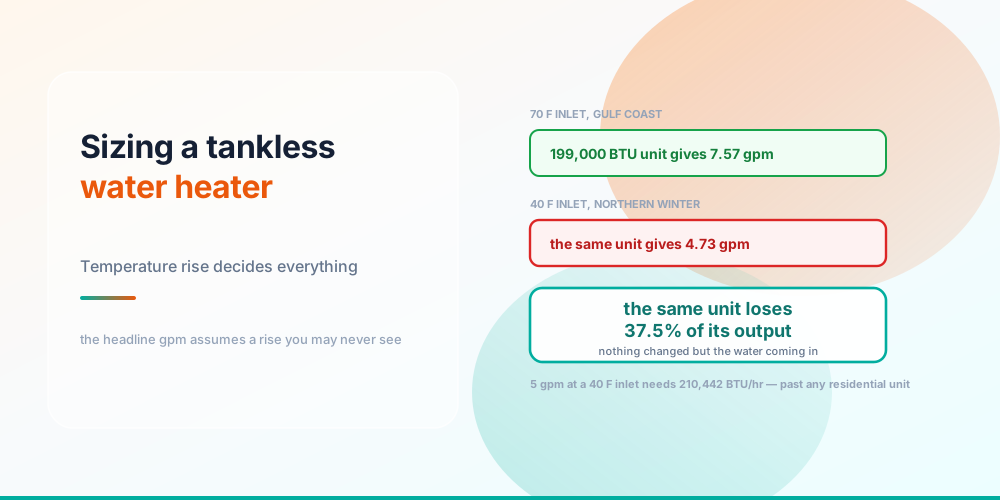
The gpm figure on the front of a tankless water heater is true. It is just true about a temperature rise that a lot of buyers will never experience.
This is the most common sizing failure in the category, and it is entirely predictable — the arithmetic is one line:
gpm = BTU/hr × efficiency ÷ (500 × temperature rise)The 500 is 8.33 lb/gal × 60 min — 499.8, rounded. Rise is a divisor. Double the rise and you halve the flow. Everything else follows from that.
The number that should decide your purchase
Take a 199,000 BTU/hr condensing unit at 95% efficiency, delivering 120 °F, and vary nothing but the water coming in.
The same 199,000 BTU unit at five inlet temperatures
7.57 gpm on a 70 °F Gulf-coast inlet. 4.73 gpm on a 40 °F northern-winter inlet. The same unit, on the same gas line, loses 37.5% of its output between the two.
Nothing is wrong with the heater. Nothing is wrong with the published figure either — manufacturers state a rise alongside it. It is simply that the headline number assumes a rise a cold-climate buyer will not see in the month they most care about.
The Tankless Water Heater Calculator takes your own inlet temperature and target and gives the flow you will actually get.
Reading it the other way
Start from the flow you want and it demands an input.
BTU/hr a target flow demands, against the 199,000 ceiling
At a 70 °F inlet, 5 gpm needs about 131,500 BTU/hr — comfortably available. At a 40 °F inlet the same 5 gpm needs 210,442 BTU/hr, which is past where residential units stop.
That ceiling is not arbitrary. 199,000 BTU/hr is the standard top of the residential range because 200,000 puts the appliance into a different category for venting and gas piping. So in a genuinely cold climate, 5 gpm is not available from a single residential unit at all. Two units in parallel is the honest answer, and it should be priced at the quote stage rather than discovered in December.
The other half: simultaneity
A tankless heater does not run out of hot water. It runs out of flow — and the failure mode is different from a tank’s.
Simultaneous demand against one unit at a 70 F rise
When a tank is exhausted, the last person in gets cold water and everyone before them was fine. When a tankless unit is asked for more flow than it can heat, the whole house drops in temperature simultaneously — the shower goes lukewarm while the kitchen tap is running, and recovers when the tap shuts.
That is why a tank buffers simultaneity and a tankless does not, and why the sizing question for a tankless is “what runs at the same time” rather than “how much do we use.” Two showers and a sink is 5.5 gpm. On a 70 °F rise, one 199k unit handles it. On a 40 °F rise it does not, and no amount of daily-usage arithmetic would have told you.
Sizing it properly
1. Get your real inlet temperature. Not the annual average — the coldest month. Municipal supply in the northern US routinely arrives at 40 °F or below in late winter. Well water is steadier but often cold year-round.
2. Pick your delivery temperature. 120 °F is the usual target at the fixture. Note this is not the same decision as a tank, where you store hot and temper down — a tankless makes water to the setpoint on demand, so there is no storage to keep out of the Legionella range.
3. Rise is the difference. 120 − 40 = 80 °F in the hard case.
4. Decide what runs at once. Be realistic and slightly pessimistic. Shower 2.0 gpm, kitchen sink 1.5, tub fill 4.0.
5. Check the unit at your rise, not its headline. This is the step that gets skipped.
What else the install needs
Tankless conversions are rarely a like-for-like swap, and the extras are where the budget goes.
Gas supply. A 199,000 BTU unit typically outgrows the 1/2 inch branch that fed a 40,000 BTU tank — often by a factor of four or five on input. Upsizing the gas line back to the meter is common and is frequently the largest single line on the job. Size it with the shared Gas Line Sizing Calculator.
Venting. Condensing units need their own category-appropriate vent, usually PVC, and cannot share the old flue.
Condensate. A condensing unit produces acidic condensate that needs a drain and often neutralisation.
Electrical. Even gas units need power for the controls and fan.
Taken together, a tankless conversion with the full upgrade set runs about $4,240 against roughly $2,070 for a like-for-like tank swap — near enough double. The Water Heater Replacement Cost Calculator breaks out which upgrades apply to your case.
Is tankless worth it?
Genuinely depends, and the honest version of the answer is:
Good fit — warm inlet climate, moderate simultaneous demand, space at a premium, long expected tenure, or an application with unlimited-duration draws such as a large tub.
Poor fit — cold inlet with high simultaneous demand, an existing gas line that needs upsizing back to the meter, or a household whose real complaint is wait time at the tap. Wait time is pipe volume, and a tankless makes it slightly worse because the unit has to fire before hot water starts moving. That is a pipe volume problem — 50 ft of 3/4 inch copper holds 1.26 gallons and takes 38 seconds to clear — and the fix is recirculation or a smaller bore, not a different heater. Why hot water takes so long covers it in full.
If storage suits the house better, what size water heater do I need covers sizing a tank on first-hour rating — and tankless vs tank puts the two side by side, including the roughly ten-minute mark where the tankless overtakes a 50 gallon tank and never gives the lead back.
Frequently asked questions
What size tankless water heater do I need?
Work from temperature rise, not household size. Subtract your coldest-month inlet temperature from your target delivery temperature, decide what fixtures run simultaneously, then check a unit’s output at that rise. A 199,000 BTU unit gives 7.57 gpm at a 50 °F rise and 4.73 gpm at 80 °F. The Tankless Water Heater Calculator does it directly.
Why does my tankless water heater not keep up in winter?
Because incoming water is colder, the required temperature rise is larger, and rise is a divisor in the capacity equation. The same unit that delivered 7.57 gpm on a 70 °F summer inlet delivers 4.73 gpm on a 40 °F winter inlet — a 37.5% loss with no fault in the appliance.
How many gpm do I need for a whole house?
Add the fixtures that genuinely run at once: a shower is about 2.0 gpm, a kitchen sink 1.5, a tub fill 4.0. Two showers plus a sink is roughly 5.5 gpm. Whether one unit covers that depends entirely on your rise — at a 70 °F inlet it does, at 40 °F it does not.
Can one tankless unit serve two bathrooms?
In a warm-inlet climate, usually yes. In a cold-inlet climate, often not — 5 gpm at a 40 °F inlet needs 210,442 BTU/hr, past the 199,000 residential ceiling. Two units in parallel is the standard answer, and it belongs in the quote rather than the callback.
What is the temperature rise on a tankless water heater?
The difference between incoming water and delivered water. A 40 °F inlet with a 120 °F target is an 80 °F rise. It is the single most important input, because gpm = BTU/hr × efficiency ÷ (500 × rise) — the rise divides the answer.
Do I need a bigger gas line for a tankless?
Very often. A 199,000 BTU/hr unit needs roughly four to five times the input of the 40,000 BTU tank it replaces, and the existing 1/2 inch branch usually cannot carry it. Upsizing back to the meter is frequently the biggest single cost on a conversion — size it with the Gas Line Sizing Calculator.
Does a tankless water heater save money?
Standby losses go away, which is real but modest. Against that sits a higher unit price and a materially higher installed cost — about $4,240 with the full upgrade set against roughly $2,070 for a like-for-like tank swap. Payback is plausible over a long tenure in a high-rate market and unlikely over a short one.
Will a tankless give me hot water faster?
No — slightly slower, if anything. The wait at a tap is the water already sitting in the pipe, and a tankless adds a moment of firing delay on top. Fifty feet of 3/4 inch copper holds 1.26 gallons and takes about 38 seconds to clear at 2 gpm regardless of what is heating it.
Sources & standards: the capacity relationship gpm = BTU/hr × efficiency ÷ (500 × rise) derives from 8.33 lb/gal × 60 min = 499.8; figures here are computed from the same model the calculator uses. IPC 2021 Chapter 5 for water heater installation and the IFGC for gas piping and venting. The 199,000 BTU/hr residential ceiling reflects the threshold at which appliance venting and gas-piping requirements change. The IPC is a model code — confirm the edition your jurisdiction adopts, and have a licensed plumber size the gas line and sign off anything installed.