
NEC 2023 vs 2026: The Changes That Affect Everyday Work
- 04 Aug, 2026
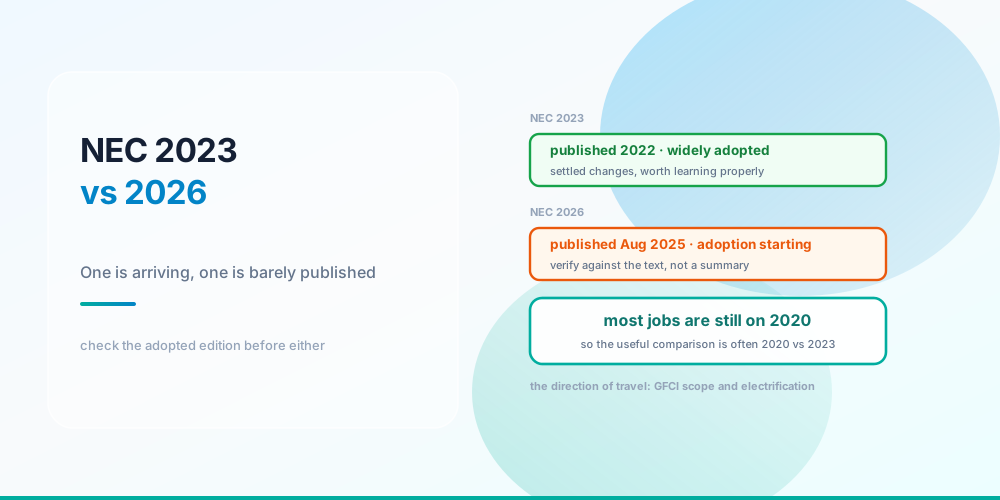
NEC 2026 was published in August 2025. Adoption has barely begun, and since jurisdictions typically take one to four years to adopt an edition, the overwhelming majority of work being inspected right now is being inspected against 2020 or 2023.
So the practically useful comparison for most people isn’t 2023 versus 2026 at all - it’s whether your jurisdiction has moved from 2020 to 2023 yet, and which sections survived the move.
A note on scope, stated plainly: the 2023 changes below are settled and verifiable. For 2026, I’m describing the direction of travel and the process rather than publishing a detailed section-by-section change list - a newly published edition deserves to be read in the actual text rather than through a compressed summary, and change summaries reliably lose the exceptions that matter. Where you need 2026 detail, go to the book.
The 2023 Changes That Reach Ordinary Jobs
The 2023 changes that reach ordinary jobs
Settled
210.52(C)(2) - island and peninsula receptacles no longer required. The 2020 cycle required them by countertop area; 2023 removed the requirement, though location rules still apply where a receptacle is installed. This one runs the “wrong” way - the newer code requires less, so a 2020 jurisdiction is stricter than a 2023 one. Anyone who assumes newer means stricter will over-build here. Receptacle Spacing Rules.
230.85 - outdoor emergency disconnect for one- and two-family dwellings. This materially changes the scope of a panel replacement: a straightforward indoor panel swap becomes a job that includes an exterior disconnect. Combined with the 230.71(A) change below, it’s why replacing an old split-bus panel is a bigger job than it looks. Main Breaker vs Main Lug Panels and Electrical Panel Upgrade Cost.
230.67 - surge protection at dwelling services. An SPD is now part of a service change rather than an upsell.
Article 235 - over-1000 V requirements consolidated. A reorganisation that moved existing high-voltage text into one article. No residential impact, but worth knowing so a renumbered section doesn’t read as a new rule.
Contested - check before you design to it
210.8(D) - GFCI for specific appliances. Introduced for dishwashers in the 2020 cycle and reaching further into cooking and other equipment since. Amended out or delayed in a number of jurisdictions, partly because early appliance generations produced nuisance trips.
210.8(F) - GFCI for all outdoor dwelling outlets. Added in 2020, and it caught air-conditioning condensers - equipment not designed for GFCI protection, producing genuine nuisance tripping and a substantial wave of state amendments and delays.
These two are the most-amended provisions in recent memory, which is why Where GFCI Protection Is Required presents them with their adoption status rather than as settled requirements.
Two Earlier Changes Still Catching People
Not 2023, but still surprising people because they’re recent enough that the old rule is what got learned:
230.71(A) - one service disconnect per enclosure, from the 2020 cycle. Two to six service disconnects are still permitted, but each must be in a separate enclosure - which ended the six-handle split-bus panelboard as a new installation.
The rooftop ambient adder - removed in the 2017 cycle. Older editions added up to 33 °C to the ambient for raceways exposed on a roof. If you learned that rule, check whether your edition still has it. Wire Derating Explained.
Where the Code Is Heading
Knowing the direction beats memorising the list
| Theme | Direction |
|---|---|
| GFCI and AFCI scope | Widening, cycle after cycle - and the most amended area |
| Electrification capacity | Load management formalised rather than bigger services |
| Energy storage and PV | Growing and restructuring |
| Panel serviceability and safety | More required hardware |
| Reorganisation | Renumbering without new rules |
The electrification theme is the most useful one to internalise, because it changes how you answer a common question. Rather than expecting the code to demand ever-larger services, recent cycles have given formal standing to controlled loads - 625.42 lets an EVSE be calculated at a managed value rather than nameplate, and Article 750 provides the general energy-management framework.
That means the correct answer to “the service isn’t big enough” is increasingly “manage the load” rather than “upgrade the service,” and the code supports it. See Do You Need a Panel Upgrade for an EV Charger and NEC 220.87.
And watch for reorganisation specifically. A renumbered section reads exactly like a new requirement to anyone scanning a change list, and treating Article 235 as new rules rather than moved text wastes real time.
What Hasn’t Changed
Worth stating, because change lists give a misleading impression of churn. The load-bearing fundamentals are stable:
- Table 310.16 ampacities. Unchanged for decades.
- 240.4(D) small-conductor caps - 15 A for 14 AWG, 20 A for 12, 30 A for 10.
- 110.14(C) termination temperature limits, and the rule that you derate from the conductor’s column.
- Table 314.16 box fill, and the counting rules.
- Table 250.122 and Table 250.66 for EGC and GEC sizing.
- Chapter 9 conduit fill.
- 220.82 and 220.87 load calculation methods.
- Article 430 motor rules, including the 240.4(G) exemption.
If you know those cold, you know most of what you need across every recent edition. The NEC Tables reference collects them.
What to Actually Do
A new edition is a planning input, not a working document
Learn the edition you’re inspected against, which for most jurisdictions is 2020 or 2023. NEC Adoption by State covers how to establish which.
Read your state’s amendment document. It’s usually short and it’s the operative text - it’s what tells you whether 210.8(D) and 210.8(F) apply to you.
Track your state’s 2026 adoption process. Adoption involves public comment, and that’s where amendments get made. Contractors who participate shape the rules they’ll work under; most don’t, and then complain about the result.
Before designing to 2026, read the actual text. Not a summary - including this one. Summaries compress, and what gets compressed away is usually an exception that matters on a real job.
Ask the AHJ in writing on anything genuinely ambiguous. 90.4 gives them interpretive authority, so their answer is the answer. Electrical Permits and Inspections.
Common Mistakes
- Designing to the newest published edition. Adoption lags by years, and 210.52(C)(2) shows newer can require less.
- Assuming 210.8(D) and 210.8(F) apply. They’re the most amended provisions in recent cycles.
- Reading a reorganisation as new rules. Article 235 moved text; it didn’t add requirements.
- Pricing a panel swap without 230.85. The outdoor emergency disconnect changes the scope.
- Quoting the rooftop ambient adder. Largely removed in the 2017 cycle.
- Planning a six-handle service. 230.71(A) has permitted one disconnect per enclosure since 2020.
- Trusting a change summary for design. Read the section, including its exceptions.
- Ignoring the adoption comment period. It’s where the amendments you’ll live with get decided.
- Assuming the fundamentals moved. Ampacity, box fill, derating and grounding tables are stable.
Work From the Tables
NEC Tables Reference - Table 310.16, the derating factors, Table 240.6 ratings, the Chapter 9 conduit data, Table 314.16 box volumes and the grounding tables, imported directly from the same source the calculators use so the values can’t drift.
The calculators here use NEC 2023 as a baseline, with contested provisions flagged rather than asserted. See NEC Adoption by State for establishing your edition, Common NEC Violations for what gets flagged in practice, and Where GFCI Protection Is Required for the most-amended area of the code.
Sources & standards: NEC (NFPA 70) - 2023 edition provisions at 90.4, 210.8(D), 210.8(F), 210.52(C)(2), 230.67, 230.71(A), 230.85, Article 235, 625.42, Article 750; 2017-cycle removal of the rooftop ambient adder formerly at 310.15(B)(3)(c). NEC 2026 was published in August 2025; this article deliberately does not enumerate its changes section by section, and anyone designing to 2026 should work from the published text rather than a summary. Adoption status and amendments vary by jurisdiction and change continually - the AHJ has final say.
FAQ
When was NEC 2026 published?
August 2025 - the NFPA publishes each edition roughly a year before its edition year. Publication is not adoption, though: jurisdictions typically take one to four years to adopt an edition, and some skip one entirely. As a result most work being inspected now is judged against the 2020 or 2023 edition.
Should I be working to NEC 2026?
Only if your jurisdiction has adopted it, which few had done shortly after publication. Working to an unadopted edition can actually fail inspection, because some newer provisions require less than older ones - 210.52(C)(2) removed the island receptacle requirement that 2020 imposed, so a 2023-or-later design would under-build in a 2020 jurisdiction.
What are the most important NEC 2023 changes?
For everyday residential work: 210.52(C)(2) removed the island and peninsula receptacle requirement; 230.85 requires an outdoor emergency disconnect for one- and two-family dwellings, which changes panel-replacement scope; 230.67 requires surge protection at dwelling services; and the GFCI expansions in 210.8(D) and 210.8(F) widened protection - though those two are widely amended out.
Which NEC changes are most often amended out by states?
The recent GFCI expansions, without much competition. 210.8(D) for specific appliances and 210.8(F) for all outdoor dwelling outlets have both been deleted or delayed in a number of jurisdictions. 210.8(F) attracted particular resistance because it caught air-conditioning condensers, which produced real nuisance tripping on equipment not designed for GFCI protection.
Does a newer NEC edition always require more?
No, and assuming so causes real errors. The 2023 edition removed the island and peninsula receptacle requirement that 2020 had added, so on that point the newer code is less demanding. Some changes are also pure reorganisation - Article 235 consolidated existing over-1000 V text without altering any requirement - which reads like new rules on a change list and isn’t.
What is the emergency disconnect requirement?
NEC 230.85, requiring a readily accessible outdoor disconnecting means for one- and two-family dwellings so first responders can de-energise a building from outside. Its practical effect is on panel replacements: what would have been an indoor panel swap now includes exterior work, which changes both the price and the permit scope.
What hasn’t changed between recent editions?
The fundamentals, which is most of what you use daily. Table 310.16 ampacities, the 240.4(D) small-conductor caps, the 110.14(C) termination rules, Table 314.16 box fill and its counting rules, Tables 250.122 and 250.66 for grounding conductors, Chapter 9 conduit fill, the 220.82 and 220.87 load calculation methods, and the Article 430 motor rules including the 240.4(G) exemption.
How can I influence what my state adopts?
Participate in the adoption process. Code adoption involves public comment periods, and state electrical boards and building code councils hold meetings that are generally open. That’s where amendments - including the deletions of provisions like 210.8(F) - actually get made. Trade associations and utilities participate consistently; individual contractors rarely do, and then work under the result.