
Do You Need a Panel Upgrade for an EV Charger? (And the Load-Management Alternative)
- 04 Aug, 2026
The quote says you need a service upgrade before you can charge a car. Sometimes that’s true. Far more often it’s the first answer rather than the right one, because three cheaper questions never got asked.
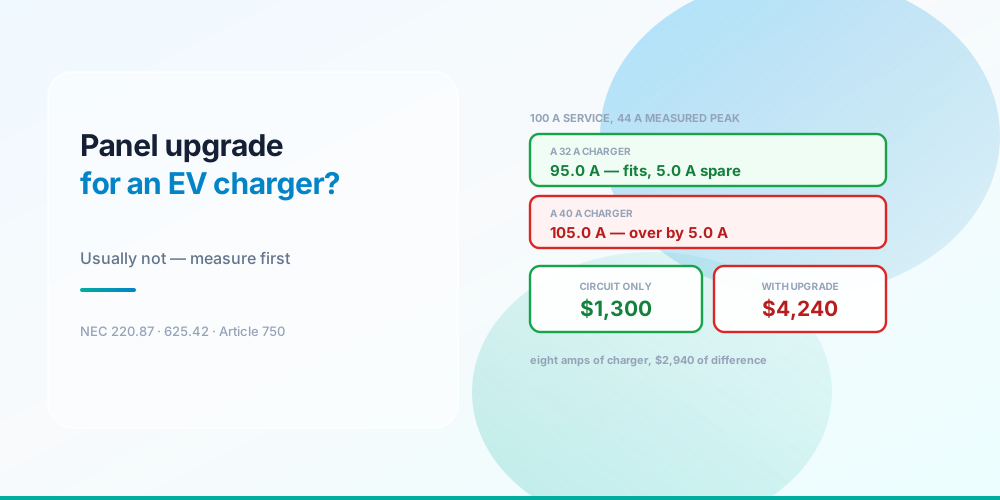
Here’s the case that shows why it matters. A house with a 100 A service and a utility-recorded 12-month peak of 44 A has an established existing load of 55.0 A under NEC 220.87.
- A 32 A charger adds 40.0 A → 95.0 A. Fits, with 5.0 A spare.
- A 40 A charger adds 50.0 A → 105.0 A. Over by 5.0 A.
Eight amps of charger is the difference between a $1,300 job and a $4,240 one. And the 32 A charger delivers 25–30 miles of range per hour, which is 250+ miles overnight - more than almost anyone needs.
Ask the Cheap Questions First
Four questions, in ascending order of cost
1. Run NEC 220.87 against the utility’s demand data. Free, and it typically produces a figure 40–50% below a calculated load. On the worked house, the optional calculation says 101.2 A - over the service - while the measured method says 55.0 A. Both are legal; one reflects the house that exists. The method is in NEC 220.87.
2. Specify the charger you need rather than the largest available. A 48 A charger is the default recommendation from almost everyone selling hardware, and for home overnight charging it’s overkill.
3. Use load management. NEC 625.42 permits an EVSE to be rated at less than its maximum where an energy management system limits it, and Article 750 covers energy management generally. A managed charger sheds when the service nears capacity. Costs hundreds; nobody quotes it.
4. Then, if you must, upgrade. Legitimate, sometimes necessary, and thousands.
How Much Charger a Service Takes
How much charger the service will actually take
| Measured peak | 100 A service | 125 A service | 200 A service |
|---|---|---|---|
| 30 A | 48 A | 48 A | 48 A |
| 40 A | 32 A | 48 A | 48 A |
| 48 A | 32 A | 40 A | 48 A |
| 60 A | 16 A | 24 A | 48 A |
A 100 A service takes a 32 A charger up to a 48 A measured peak - and a great many real houses sit under that, especially with gas heat, gas water heating and gas cooking.
Note how the arithmetic works: the charger is a continuous load by rule under 625.41, so it enters at 125%. A 32 A charger costs you 40.0 A of capacity, not 32 A. Forgetting the 1.25 is the commonest error in this calculation and it understates the load by a fifth.
A 200 A service takes a 48 A charger at every peak shown, which is why this whole conversation is mostly about 100 A and 125 A services.
What Each Path Costs
Three paths, and the middle one rarely gets quoted
| Path | Cost | When it’s right |
|---|---|---|
| Circuit only | $1,300 | The service has headroom - verify with 220.87 |
| Circuit + load management | ~$2,000 | The service is close, and the charger can shed |
| Circuit + service upgrade | $4,240 | The service genuinely can’t carry it |
The upgrade path is 3.3× the circuit-only cost, and the reason is the panel upgrade itself: $3,060 for a 200 A upgrade including meter, conductors, mast, permit and labour. Full breakdowns are in EV Charger Installation Cost and Electrical Panel Upgrade Cost.
Load Management - The Underused Middle Option
This is the part worth knowing about, because it’s a genuine engineered solution rather than a compromise.
625.42 permits the EVSE load to be calculated at less than the nameplate rating where an energy management system limits the current. Article 750 provides the general framework. In practice:
A managed charger monitors the service and reduces or interrupts charging as total demand approaches capacity. Most current EVSE from major manufacturers supports this natively, sometimes with a CT clamp on the service conductors.
A load-shedding relay on a large discretionary load - commonly an electric water heater or a dryer - that opens while the car charges. Simple, cheap, and effective because those loads are genuinely deferrable.
A “smart splitter” device sharing one circuit between a dryer and a charger with an interlock, so only one runs at a time.
Two things to be clear about. The management has to be listed equipment configured to limit the load - a homeowner’s promise to charge only at night isn’t a load-management system. And because the calculated load is reduced by the control rather than by the hardware, the AHJ needs to see how the limiting works, so document it.
Also worth knowing: most modern EVSE is field-adjustable. A 48 A unit commissioned at 32 A gives you the hardware headroom for a future upgrade without needing one now - but it must be a set-and-documented configuration, not a preference.
When an Upgrade Really Is the Answer
Don’t over-rotate on avoiding it. Upgrade when:
The measured load genuinely doesn’t fit even with a smaller charger and management.
The panel is obsolete or hazardous. FPE Stab-Lok, Zinsco, Challenger - these were never federally recalled, but independent testing found high failure-to-trip rates, most inspectors treat them as replace-on-sight, and some insurers decline coverage. If you’re touching that panel at all, replace it.
There’s no physical space and no room for tandems. Panel spaces are a separate limit from service capacity, and 220.87 says nothing about them.
The service equipment is already at its limit - busbar rating, main breaker and service conductors are three independent numbers and the smallest governs. See What Size Electrical Service Do I Need and Main Breaker vs Main Lug Panels.
You’re adding other electrification anyway. If a heat pump and an induction range are coming, do the arithmetic once for all of it.
The Circuit Itself
Once you’ve settled the charger size, the circuit follows a clean ladder - and 48 A is the sweet spot, because 50 × 1.25 = 62.5 A isn’t a standard rating, so a 50 A charger jumps to a 70 A breaker and two extra wire sizes:
| Charger | Breaker | Copper |
|---|---|---|
| 32 A | 40 A | 8 AWG |
| 40 A | 50 A | 8 AWG |
| 48 A | 60 A | 6 AWG |
| 50 A | 70 A | 4 AWG |
One trap worth repeating: NEC 334.80 holds NM cable to the 60 °C column, where 6 AWG is only 55 A - so 6/3 Romex on a 48 A charger’s 60 A circuit is a violation. It needs 4 AWG NM, or 6 AWG THWN-2 in conduit. Full detail in What Size Wire for an EV Charger and THHN vs NM-B vs MC Cable.
Also: a 14-50 receptacle can only serve 40 A of continuous load (50 ÷ 1.25), which is the real reason every plug-in EVSE is 40 A and everything above is hardwired.
A Genuine Code Ambiguity
Whether EVSE load receives the 220.82(B) 40% remainder discount in the optional calculation is interpreted differently by different AHJs, and 220.57 sets a 7,200 VA or nameplate minimum for EVSE load. Under 220.87 the question doesn’t arise - the new load is added at 125% with no remainder factor to argue about, which is one more reason the measured method produces a cleaner conversation with an inspector.
Note also that incentives change constantly. Federal, state and utility EV-charging programmes have been amended repeatedly, so verify current eligibility rather than relying on a figure quoted anywhere - including here.
Common Mistakes
- Quoting an upgrade before running 220.87. The measured method is free and usually decisive.
- Forgetting the 125% continuous factor. A 32 A charger costs 40.0 A of capacity.
- Defaulting to a 48 A charger. 32 A is 25–30 miles of range per hour; overnight that’s plenty.
- Not offering load management. 625.42 and Article 750 make it a legitimate engineered answer.
- Treating a promise as load management. It has to be listed equipment that actually limits the load.
- Assuming 220.87 covers panel spaces. It addresses service capacity only.
- 6/3 Romex on a 60 A circuit. 334.80 caps 6 AWG NM at 55 A.
- Putting a >40 A charger on a 14-50 receptacle. 50 ÷ 1.25 = 40 A of continuous load.
- Keeping a hazardous panel because the load fits. If it’s FPE or Zinsco, replace it regardless.
Check Your Own Service
Existing Load Calculator - enter your utility’s recorded 12-month peak, your service rating and the charger current, and it applies both 125% factors and tells you whether it fits, with how much headroom.
Then price the paths with the EV Charger Install Cost Calculator and the Panel Upgrade Cost Calculator, and size the circuit with the EV Charger Calculator. See Do I Need a Panel Upgrade for the general case.
Sources & standards: NEC (NFPA 70) 2023 - 220.57, 220.82(B), 220.87, 625.41, 625.42, Article 750, 334.80, 210.20(A), Table 310.16. Cost figures are the calculators’ default outputs and vary substantially by region and site. Incentive programmes change frequently - verify current eligibility. Panel-obsolescence guidance reflects inspector and insurer practice, not a recall. Have EV charger circuits installed by a licensed electrician under permit.
FAQ
Do I need a panel upgrade to install an EV charger?
Usually not, and the way to find out is NEC 220.87 - the utility’s recorded 12-month peak demand times 125% establishes your existing load, and the charger is added at 125% on top. On a 100 A service with a 44 A measured peak, a 32 A charger fits with 5.0 A to spare. Most quotes skip this step and go straight to an upgrade.
What size EV charger can a 100 amp service handle?
It depends on your measured demand. With a 30 A peak, a 48 A charger fits. With a 40 A or 48 A peak, a 32 A charger fits. With a 60 A peak you’re down to 16 A without load management. Remember the charger enters the calculation at 125% because 625.41 makes it a continuous load, so a 32 A charger consumes 40.0 A of capacity.
Is a 32 amp charger enough?
For almost everyone charging at home overnight, yes. 32 A at 240 V is about 7.7 kW, which adds 25–30 miles of range per hour - over 250 miles in an overnight session. The case for 48 A is fast top-ups during the day, not daily charging. Specifying 32 A instead of 48 A is frequently the entire difference between a $1,300 circuit and a $4,240 upgrade.
What is EV load management?
Equipment that limits the charger’s draw based on what the rest of the house is doing, so the total never exceeds the service. NEC 625.42 permits the EVSE load to be calculated at the managed value rather than the nameplate, and Article 750 provides the general framework. Options include a managed charger with a CT on the service, a load-shedding relay on a water heater or dryer, or a smart splitter sharing a dryer circuit.
Can I just promise to charge only at night?
No. Load management has to be listed equipment that actually limits the load - a behavioural commitment isn’t a system, and an inspector won’t accept it. What you can do is have a 48 A charger commissioned at a lower current setting, since most modern EVSE is field-adjustable, provided that configuration is set and documented rather than left as a preference.
How much does a panel upgrade for an EV charger cost?
Around $4,240 all-in for the circuit plus a 200 A service upgrade, of which about $3,060 is the upgrade itself including panel, meter, conductors, mast, permit and labour. The circuit alone is about $1,300. Load management sits in between at roughly $2,000. Regional multipliers move all of these by 15% down to 50% up.
Does a 50 amp charger cost more to install than a 48 amp one?
Noticeably, yes, and it surprises people. 48 A × 1.25 = 60 A, which is a standard breaker rating on 6 AWG copper. 50 A × 1.25 = 62.5 A, which is not a standard rating, so it rounds up to a 70 A breaker needing 4 AWG. Two amps of charger costs a breaker size and two wire sizes.
Can I use 6/3 Romex for a 48 amp charger?
No. A 48 A charger needs a 60 A circuit, and NEC 334.80 limits NM cable to the 60 °C column where 6 AWG copper is rated only 55 A. You need 4 AWG NM cable, or 6 AWG THWN-2 in conduit where the 75 °C column’s 65 A applies. This catches a lot of EV installations.