
Drainage Fixture Unit Chart: Table 709.1 With the Trap Sizes
- 02 Sep, 2026
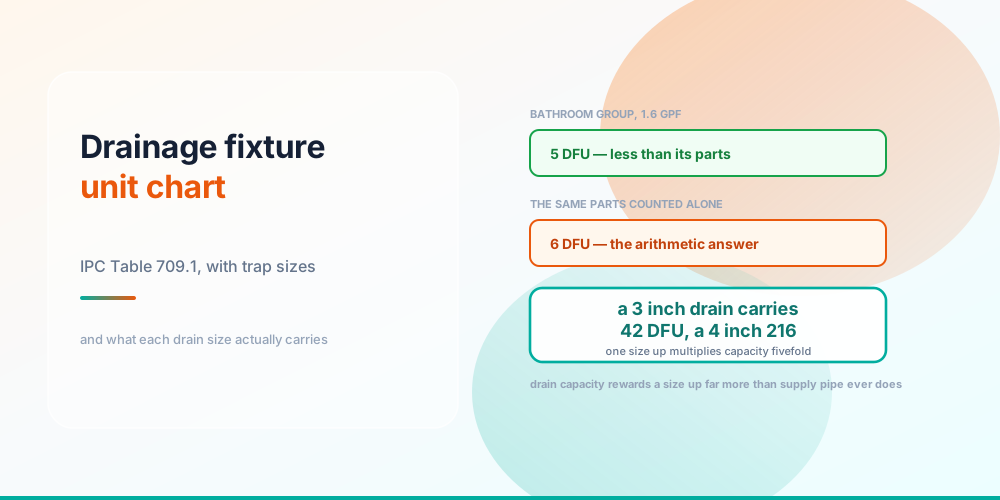
Drainage fixture units are the input to every drain-sizing decision in a building. Here are the values, with the minimum trap each fixture takes — and then the part that gets left off most charts, which is what your total actually buys.
Residential fixtures
Drainage fixture units — residential, IPC Table 709.1
Three things to notice.
A bathroom group is 5 DFU, less than its parts. A water closet (3), lavatory (1) and shower (2) counted separately come to 6. The code discounts the group because one person cannot use all three at once. Use the group value only when the fixtures genuinely form a bathroom group.
Water closets show “integral” for trap size. The trap is moulded into the china. You do not add one underneath, and a toilet with a P-trap below it is a double trap — a real violation, because the air lock between two traps stops the drain flowing.
The gpf threshold matters. A 1.6 gpf water closet is 3 DFU; anything over 1.6 gpf is 4. Older fixtures carry a heavier weight, which occasionally matters on a remodel where the existing toilets are staying.
Commercial fixtures
Drainage fixture units — commercial, IPC Table 709.1
The public-versus-private split trips people up on mixed-occupancy work. It is not about the fixture — it is about how often it gets used. A toilet in an office lobby cycles far more than the identical toilet in an apartment, so it carries a heavier weight.
Note the waterless urinal at 0.5 DFU and the drinking fountain at 0.5. Half-unit values are real and they do add up in a large building.
What the total actually buys
This is the half that most DFU charts omit, and it is the half that answers the question you actually had.
What each building drain size carries at 1/4 in per foot
A 2 inch building drain carries 21 DFU. A 3 inch carries 42 — double. A 4 inch carries 216, more than five times the 3 inch.
That non-linearity is worth internalising. Drain capacity rises much faster than diameter, far faster than supply pipe capacity does, because a larger pipe has proportionally less wetted perimeter dragging on the flow. One size up on a drain is a bigger win than one size up on a water line.
Add your own fixtures with the Drainage Fixture Unit Calculator and size the pipe with the Drain Pipe Size Calculator.
Four things the chart will not tell you
The application changes the answer. There is no single “drain size for 18 DFU”. A building drain, a horizontal fixture branch and a stack all read different tables, and a horizontal branch often needs a larger pipe than the building drain it discharges into. Covered in what size drain pipe do I need.
A water closet overrides the arithmetic. 18 DFU rides a 2 inch building drain on the table, and a single toilet anywhere on that drain floors the whole thing at 3 inch. DFU measures volume and coincidence; it says nothing about solids, and solids need bore.
A taller stack carries more. A 2 inch stack carries 10 DFU over three branch intervals or fewer, and 24 over more than three. Water reaches terminal velocity within a storey or two and settles into a stable annular sheet with an open air core — a short stack never fully develops it.
Slope matters, on drains and sewers only. A 4 inch building drain carries 180 DFU at 1/8 in/ft, 216 at 1/4 and 250 at 1/2. Horizontal branches and stacks read a table that does not vary with slope. See drain pipe slope.
Trap sizes are a floor, not a target
The trap column is a minimum. You may go larger, but there is rarely a reason to and there is one good reason not to: an oversized trap holds a deeper seal that the fixture’s own discharge may not be able to scour, so it silts.
The other rule people miss is that a trap arm may not be smaller than the trap, and the trap may not be smaller than the fixture outlet. Size flows one way — fixture outlet, trap, trap arm — and never steps down.
And distance is capped separately. A 1-1/2 inch trap arm reaches 6 ft, a 2 inch reaches 8, a 3 inch reaches 12. That is how far a vent can be from a trap.
And a commercial kitchen carries a requirement the DFU table says nothing about: fixtures discharging fats, oils and grease need an interceptor ahead of the drain, sized by a method that shares no inputs with this chart at all. That is what size grease trap do I need.
Water that never reaches this table
Not every gallon a building handles is waste. Rainwater and grey water are captured rather than drained, and they are sized by a completely different logic — the dry spell rather than the roof. Sizing a rainwater harvesting system covers it, including why quadrupling the catchment leaves the tank size unchanged.
Frequently asked questions
What is a drainage fixture unit?
A dimensionless weight representing a fixture’s discharge — how much, how fast and how often — so fixtures with different behaviour can be added and read off a sizing table. It is not gallons per minute. The coincidence assumption is already built into the table values, which is why DFU goes straight into a table with no demand curve.
How many DFU is a toilet?
A private 1.6 gpf water closet is 3 DFU; over 1.6 gpf it is 4. A public 1.6 gpf water closet is 4 DFU, and over 1.6 gpf it is 6 — the same fixture carries a heavier weight in public use because it cycles more often.
How many DFU is a bathroom group?
5 DFU with a 1.6 gpf water closet, and 6 with a toilet over 1.6 gpf. Counting the toilet, lavatory and shower individually gives 6 — the group value discounts it, because one person cannot use all three simultaneously.
How many fixture units can a 3 inch drain handle?
A 3 inch building drain at 1/4 in per foot carries 42 DFU. As a horizontal fixture branch it carries 20, and as a stack it carries 48 over three branch intervals or fewer and 72 over more than three. The application decides, not the diameter alone.
What is the difference between DFU and WSFU?
DFU measures drainage load; WSFU measures supply load. The same fixture carries different values — a water closet is 3 DFU and 2.2 WSFU — because a toilet dumps violently into the drain but draws gently from the supply. See fixture units explained.
What size trap does a kitchen sink need?
1-1/2 inch minimum, the same as a bathtub, shower up to 5.7 gpm or laundry tray. A lavatory takes 1-1/4 inch, and a residential clothes washer takes 2 inch. The trap may never be smaller than the fixture outlet, and the trap arm may never be smaller than the trap.
Does a hose bibb have a DFU value?
No. It has a supply value of 2.5 WSFU and no drainage value at all, because the water goes onto the garden. Outdoor fixtures, irrigation and hose bibbs load the supply side only.
Can I use a bigger trap than the chart says?
You may, but it is rarely a good idea. An oversized trap holds a seal the fixture’s own discharge may not scour, so it accumulates. The chart values are minimums that are also, in practice, the right answer.
Sources & standards: IPC 2021 Table 709.1 for drainage fixture unit values and minimum trap sizes, Table 710.1(1) for building drains and sewers, Table 710.1(2) for horizontal branches and stacks, and Chapter 10 for traps. The 3 inch minimum where a water closet is served comes from the footnote to Table 710.1(1). The IPC is a model code — roughly fifteen states enforce the UPC or a derivative such as California’s CPC, where fixture-unit values and sizing tables differ. Confirm the edition your jurisdiction adopts, and have a licensed plumber and your AHJ sign off anything installed.